The Fight that launched Ademir da Costa onto the world Karate stage
The year is 1982. The young Ademir da Costa, then 21 years old, receives an invitation from Master Masutatsu Oyama to compete in the 14th Japanese Championship, to be held in Tokyo, Japan.
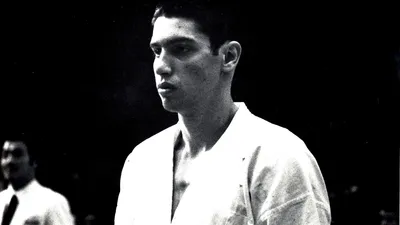
The year is 1982. The young Ademir da Costa, then 21 years old, receives an invitation from Master Masutatsu Oyama to compete in the 14th Japanese Championship, to be held in Tokyo, Japan.
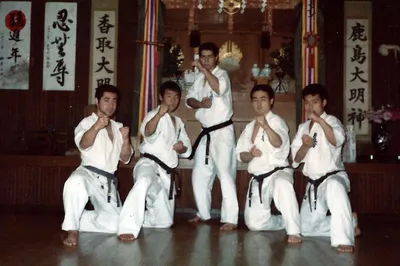
Taking part in the event was part of his 3-month exchange in Japan, where he stayed as an Uchideshi (live-in student) at the Hombu (world headquarters), training every day until the event.
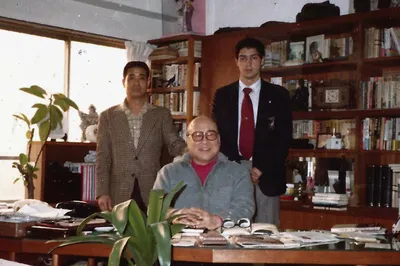
Kancho Ademir says he was apprehensive about the competition, since he would face the reigning world champion and reigning Japanese champion, Makoto Nakamura, 1.80m tall and 130kg.
Nakamura was known for literally running over his opponents, using all his brute strength to overwhelm them and always going for the knockout.
Moments before the fight, Ademir was taunted by Nakamura; even without understanding Japanese, he noticed the champion's look of contempt, and what was meant to be intimidation became fuel to win the fight.
The fight began with Nakamura imposing his overwhelming style, pressing the young Ademir da Costa at every moment, who wisely did not confront his opponent head-on, as he knew that at 74kg it would be impossible to take on a 130kg opponent directly.
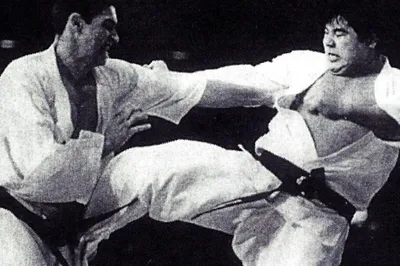
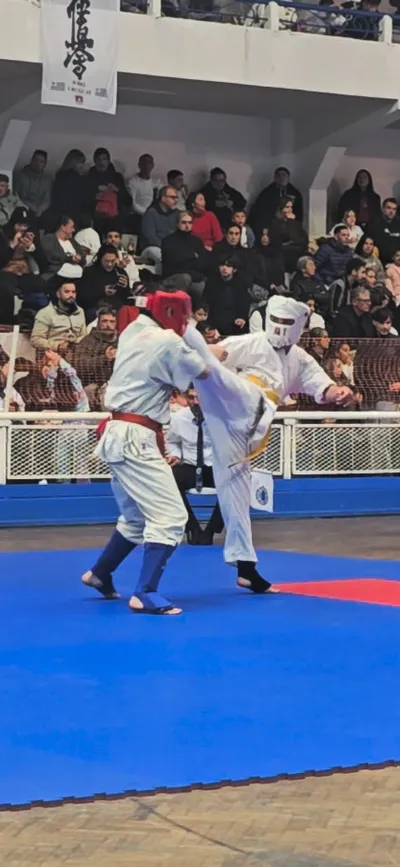
Ademir used evasion and counterattack techniques, repeatedly applying his famous "Mae" Mawashi Geri (a mawashi geri that changed its trajectory midway, making it very hard to defend), hitting Nakamura several times and even cutting his mouth.
Nakamura, in turn, could not "find" his opponent, throwing strikes that did not reach Ademir, and the strikes that did land did not have the expected effect.
The 1st 3-minute round ends in a draw, and the fight goes on to the 2nd round, where both keep the same strategy. With his technique, Ademir managed to neutralize Nakamura's strength. Another draw follows, and the 3rd and decisive round begins.
Nakamura had to go all or nothing; one more draw and the decision would come down to the scale: the athlete who weighed 10kg less would win the fight. Nakamura could not lose; after all, he was the reigning Japanese champion and reigning world champion.
Nakamura sticks to his strategy; a little more aggressive, he puts more pressure on the fight and strikes looking for the knockout, but without the desired effectiveness. Nakamura finds himself facing a problem, and it is at this moment that he loses his emotional balance and deliberately throws two punches to Ademir da Costa's face (which was forbidden by the rules, since no gloves were used), trying to destabilize, intimidate and drain all the energy from his opponent.
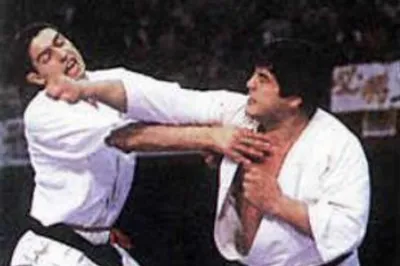
Ademir feels the blow, drops to his knees, quickly gets up and immediately returns to the fight. Nakamura is penalized his first 1/2 point, and from that moment on he saw his chances of victory slipping further and further away.
The fight resumes, and Nakamura does not think twice about committing another foul, this time even harder, throwing two consecutive punches to Ademir's face...
This time the Japanese crowd can be heard booing their own representative, who was fighting dishonorably against the foreign competitor.
Ademir feels it a little more this time, but, driven by hunger for victory, he wastes no time, quickly recovers and is ready to fight again.
The Japanese crowd is heard applauding as they see the foreigner, smaller and lighter, honor the fight and remain standing before the world champion, unshaken by his intimidation and lack of respect for the rules and the audience.
The end of the bout is near, Nakamura's desperation grows, and Ademir can clearly taste victory getting closer.
The fight ends to the applause of the Japanese crowd, and seconds later a silence falls over the arena: the judges' decision is about to come!
The atmosphere is tense. Ademir's victory was clear, but how could they give the win to a 19-year-old foreigner, in a Japanese championship, over the reigning Japanese and world champion? All this in front of the Japanese crowd and Master Masutatsu Oyama. It was a lot of pressure for the judges.
The center referee gives the command, asking the judges for the final decision of the fight. Two flags are raised for Ademir, two flags are crossed, indicating a draw.
The decision is left in the hands of the center referee, who faces a difficult choice: his vote could make the fight a draw, which under the rules would give Ademir the victory by weight, or he could give his vote to Ademir, making 3 votes and having him win the 3rd round.
At this moment the referee begins the count, looks at Masutatsu Oyama, lowers his head and gives the victory to Ademir da Costa, who, to the applause of the Japanese crowd, makes history in world Karate by handing Makoto Nakamura his first defeat to a foreigner, and also emerging as a promising future world champion, the foreigner Ademir da Costa.
In the next fight, Ademir faces Toshio Mizuguchi, at 74kg; however, Ademir was once again facing a great battle.
In 1982, it was completely out of the question for a foreigner to win the Japanese championship, let alone after eliminating the reigning world champion.
Mizuguchi had a great mission ahead of him: to defend his country against the foreigner, then unknown (to the Japanese)
Ademir and Mizuguchi fight for three long rounds in an evenly matched bout, and if there were a third draw, the fight would be decided by weight.
Since Ademir and Mizuguchi weighed practically the same (74 and 72, respectively), there would be another draw on weight, and the next tiebreaker would be tameshiwari (board breaking), in which the athlete who had broken the most boards in total would win the fight.
Ademir knew he had an advantage of 2 more boards in tameshiwari; in other words, if the fight ended in a draw, the weight would also be a draw, but he would win for having broken more boards.
The problem was that he knew it, and so did Sosai Masutatsu Oyama, and since what was taking shape there was a victory for Ademir, Master Mas Oyama decided to change the rules from that moment on: the weight difference, which had been 10kg, became just 1kg, and with that, Mizuguchi "wins" the fight.
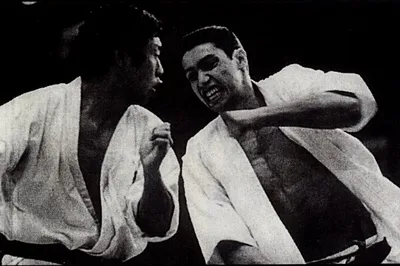
Ademir placed 6th in this event and also received from the hands of Master Masutatsu Oyama the Kantoshô trophy, awarded to the athlete who stood out most in the event for technique and fighting spirit.
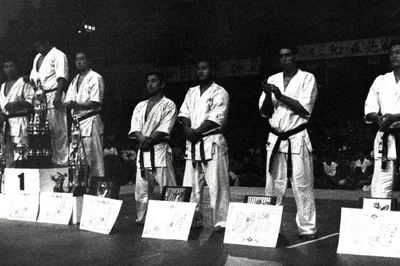
After this event, once again demonstrating his technical quality and fighting spirit, Ademir da Costa became a potential future world champion in 1984, at the 3rd World Kyokushin Karate Championship in Tokyo, Japan.
Watch the full fight at the link below

Ademir da Costa VS Makoto Nakamura (https://www.youtube.com/watch?v=BX4VkToJSiI)